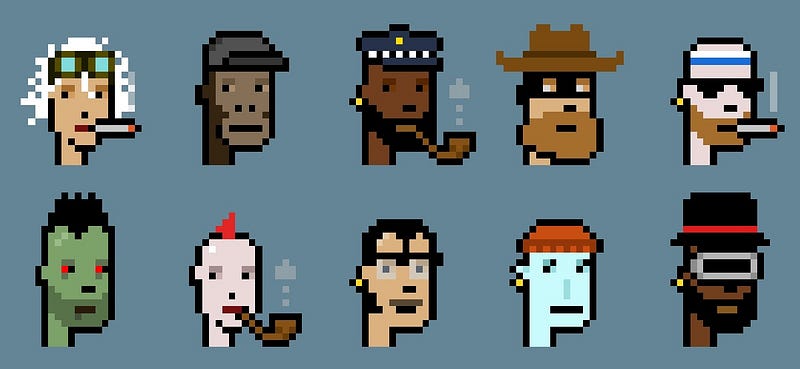
Non Fungible Tokens or (NFTs) as they are known are becoming all the rage in the blockchain and crypto world.
You have probably seen the stories of individuals who have suddenly become multi-millionaires selling artwork or have been splashing enormous sums of money on NFT digital art. I mean take this guy Mike Winkelmann who is better known as Beeple. He sold his NFT artwork collection for a massive $69 million dollars at Christie's back in February. 69 million, just think about that. How many artists in their careers or lifetime get the chance to make that sort of money from their work.
This however isn’t the only mega-money transaction involving NFTs. Musician Grimes sold a digital art collection for $4.6 million and even Twitter founder Jack Dorsey immortalized and sold his first-ever post for $2 million. If that wasn't enough how about a group of people who paid £68,000 for an original Banksy which was then burnt and sold as an NFT for £290,000.
I think you're getting the idea that with anything crypto-related there is usually a well of money close by and NFT’s are no exception.
So what is an NFT then?
An NFT is a Non Fungible Token that is simply a digital token that is generated through cryptographic hashing to create a digital asset that cannot be replicated. These then exist on a blockchain, specifically the Ethereum blockchain. They are powered through smart contracts and right now are being used to sell exclusive items, collectibles, and digital artwork on dApps and other decentralised marketplaces such as Rarible and OpenSea.
The NFT is in effect data stored in the ledger on a blockchain that identifies and certifies them as unique digital assets that are not interchangeable.
The non-fungibility aspect of them is very important as well and is probably the most important part given how they are a form of exchange. If you have a £10 note and someone borrows it from you and will give you back that £10, you don’t expect to receive the exact same note back from them. As long as it is of the same value it doesn’t matter. This is the fungibility of cryptocurrency and other fiat currencies.
However think about a piece of art like the Mona Lisa, Leonardo Da Vinci’s masterpiece. If for example the Mona Lisa was for sale and you had the money to buy it you would expect to receive the Mona Lisa, not a copy or anything like that but “the real McCoy”. There is only one Mona Lisa, it might be priceless and of cultural significance but if someone bought it then they own it, no one else has it and there isn’t another one. This uniqueness is essentially the non-fungibility aspect that is an important characteristic of NFTs.
What are they useful for?
Well right now they are very popular with digital art and collectibles but they could be used for storing any kind of data on a blockchain.
Some other use cases could include licences and certificates for authentication of real-world assets and documents. Tickets could be tokenised with NFTs used to prove that a ticket is genuine, luxury goods to prove that they are the genuine article as well as gaming for tokenisation of in-game items and assets.
Take the Ethereum name service and unstoppable domains. These were set up as a direct confrontation to the current internet and Domain Name System (DNS) by offering a P2P alternative.
This system allows people to get decentralised onto the web without the need for approval by DNS. This freedom from censorship extends to unstoppable domains due to the nature of the domains linked that are linked to crypto addresses are effectively immune from being removed by third parties.
How though does this if in with NFTs? Well, you can have a domain name that you own, that will then have all the decentralisation properties, anti-censorship, and programmability traits of Ethereum. Having wallet addresses linked to domain names essentially means they are unique to you and you can do what you want to them just like how your social media handles are unique to your account. The only difference is that social media companies don’t let really do anything with those handles other than just use them whilst you have an account on their platform.
Ethereum name service and unstoppable domains then share those non-fungible traits in the makeup of their operations.
If you really think about it, anything that you need to prove ownership of, prove that something is genuine or unique, you kind of get the idea of how non-fungibility can work in practice.
Token Standards
NFT’s adhere to ERC-721 and ERC-1155 token standards. Unlike ERC-20 standards that provide rules and regulations that must be followed in order to be compatible and inoperable with exchanges and wallets within the Ethereum network, ERC-71, and ERC-1155 provide standards for a single distinct asset that does not have interchangeability.
ERC-721 represents assets or tokenisation that are no divisible and tend to hold personalised information in smart contracts. As these smart contracts tend to be about identity and identification of a particular asset they are focused on ownership and immutability and security. The ERC-721 standards, therefore, give greater transparency to these properties.
When it comes to ERC-1155 standards these are again important for NFTs and are more suited to creating assets that can be transferred between wallets and provide an interface for smart contracts to manage multiple token types, but they do come with limitations in terms of speed.
This standard outlines a smart contract interface that can represent any number of fungible and non-fungible token types. Existing standards such as ERC-20 require deployment of separate contracts per token type. The ERC-721 standard’s token ID is a single non-fungible index and the group of these non-fungibles is deployed as a single contract with settings for the entire collection. In contrast, the ERC-1155 Multi Token Standard allows for each token ID to represent a new configurable token type, which may have its own metadata, supply and other attributes.
Source: eips.ethereum.org
Given then the popularity and surging use of NFTs in recent times I don’t think that this is just going to disappear anytime soon. They offer real-world use cases and solutions to problems but more importantly they can continue to ensure the adoption and integration of blockchains continues.
The security and nature of NFTs offer blockchains that platform to secure personal data in a way that can be trusted without the need for it being subject to sale or attack when monopolised by giant corporations and tech companies.
Don’t think though that all of it is wonderful and fantastic. There can be some serious drawbacks to NFTs especially if people feel it becomes another get rich quick scheme or that the potential for anybody to essentially create their own copy of a piece of art or even an original piece that they can subjectively give some great value to simply because it is an NFT or that the provenance is built into a smart contract has the potential to undermine the entire thing.
Keep your eyes peeled for my upcoming project around Blockchain & Defi resources for people who are getting into and looking for some information to understand concepts related to this space
As always, keep on keeping up…
If you want to find more NFT projects, find out about the market history or valuations. Visit:
Newer: ITerm 2 & ZSH script for Git Branch
Older: 5 Important Software Design Patterns…
First published on Medium.